
A to C
2D code: a barcode that stores data in two dimensions, such as DataMatrix or QR. It holds more data in less space than a linear barcode, but needs good print resolution and contrast.
Ablation: removing a thin surface layer with a laser, such as the ink on a carton, to reveal a contrasting mark underneath.
Batch or lot code: a code that identifies a production run, used for traceability and recalls.
Best-before and expiry dates: date marks that show the limit of a product's quality or safety. Which dates are required depends on the product and local labelling rules.
Character height: the height of the printed characters, usually stated in millimetres.
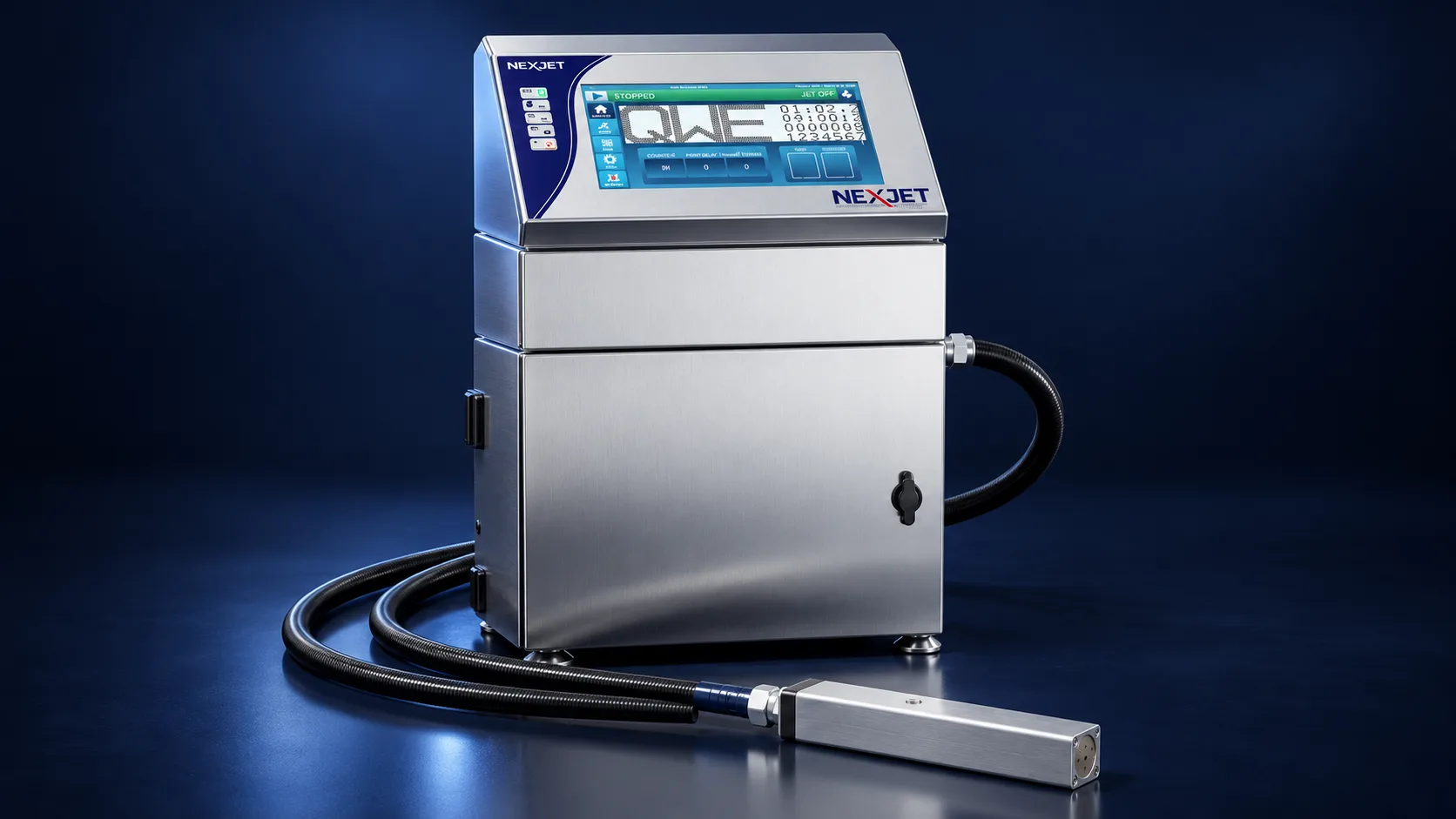
CIJ (continuous inkjet): a printer that fires a continuous stream of ink drops and steers selected drops onto the product with an electric field. See CIJ printers explained.
CO2 laser: a laser with a wavelength of around 10,600 nm, used on paper, cartons, labels, glass, PET and many plastics.
Continuous mode: a TTO printing mode in which the film keeps moving and the printhead stays still.
Contrast: the visual difference between the code and its background. It decides whether people and scanners can read the code reliably.
D to F
DataMatrix (GS1 DataMatrix): a square 2D code. The GS1 version is used for product identification, serialisation and pharmaceutical track and trace.
Decap time: how long an inkjet nozzle can stay uncapped and idle before the ink dries and affects the first prints.
Deflection plates: high-voltage plates in a CIJ printhead that steer charged ink drops onto the product.
DPI (dots per inch): a measure of print resolution. Higher DPI gives sharper codes but can reduce the maximum line speed.
Encoder: a sensor that measures line speed so the printed code keeps the correct length when the line speeds up or slows down.
Fiber laser: a laser with a wavelength of around 1,064 nm, used on metals and many hard plastics.
Flying (on-the-fly) marking: laser marking of products while they move, using an encoder to follow the line.
Fume extraction: a system that removes and filters the fumes and particles released during laser marking.
G to L
GS1: the global organisation that sets barcode standards such as GTIN and GS1 DataMatrix. National GS1 member organisations issue company prefixes to manufacturers.
Gutter: the part of a CIJ printhead that catches unused drops and returns them to the ink system.
Hijri date: a date in the Islamic calendar. Some packs in Saudi Arabia and the GCC show it alongside the Gregorian date, so the printer software must be able to calculate it.
Inline printer: a printer fixed on the production line that codes products as they pass, as opposed to a handheld printer.
Intermittent mode: a TTO printing mode in which the film stops and the printhead moves across it.
IP rating: the ingress-protection rating defined in IEC 60529. The first digit covers dust and solids, the second covers water; IP65, for example, means dust-tight and protected against water jets.
M to P
Make-up fluid: solvent that a CIJ printer adds to its ink to replace evaporation and keep the viscosity correct. Consumption rises in hot conditions.
Marking field: the area a laser can mark without moving the product or the head, set mainly by the lens.
Non-porous: a surface that does not absorb ink, such as plastic, glass, metal or coated film. It usually needs fast-drying solvent inks.
Nozzle: the opening the ink leaves through. In CIJ, nozzle size affects character size and speed.
Photocell (product detect): a sensor that detects each product and triggers the print.
Pigmented ink: ink containing solid pigment, such as white or yellow, for contrast on dark surfaces. The pigment must be kept stirred so it does not settle.
Porous: a surface that absorbs ink, such as paper, carton or wood.
Printhead: the part of a printer that forms the code. In thermal inkjet it is built into each cartridge.
R to T
Ribbon (wax-resin, resin): the ink-coated film used by thermal transfer printers. Resin ribbons resist scratching, heat and chemicals better than wax-resin.
Serialisation: giving each pack a unique code, usually in a 2D code, so it can be tracked through the supply chain.
Substrate: the material being printed or marked.
Throw distance: the gap between printhead and product at which print quality stays acceptable. CIJ tolerates a larger gap than thermal inkjet.
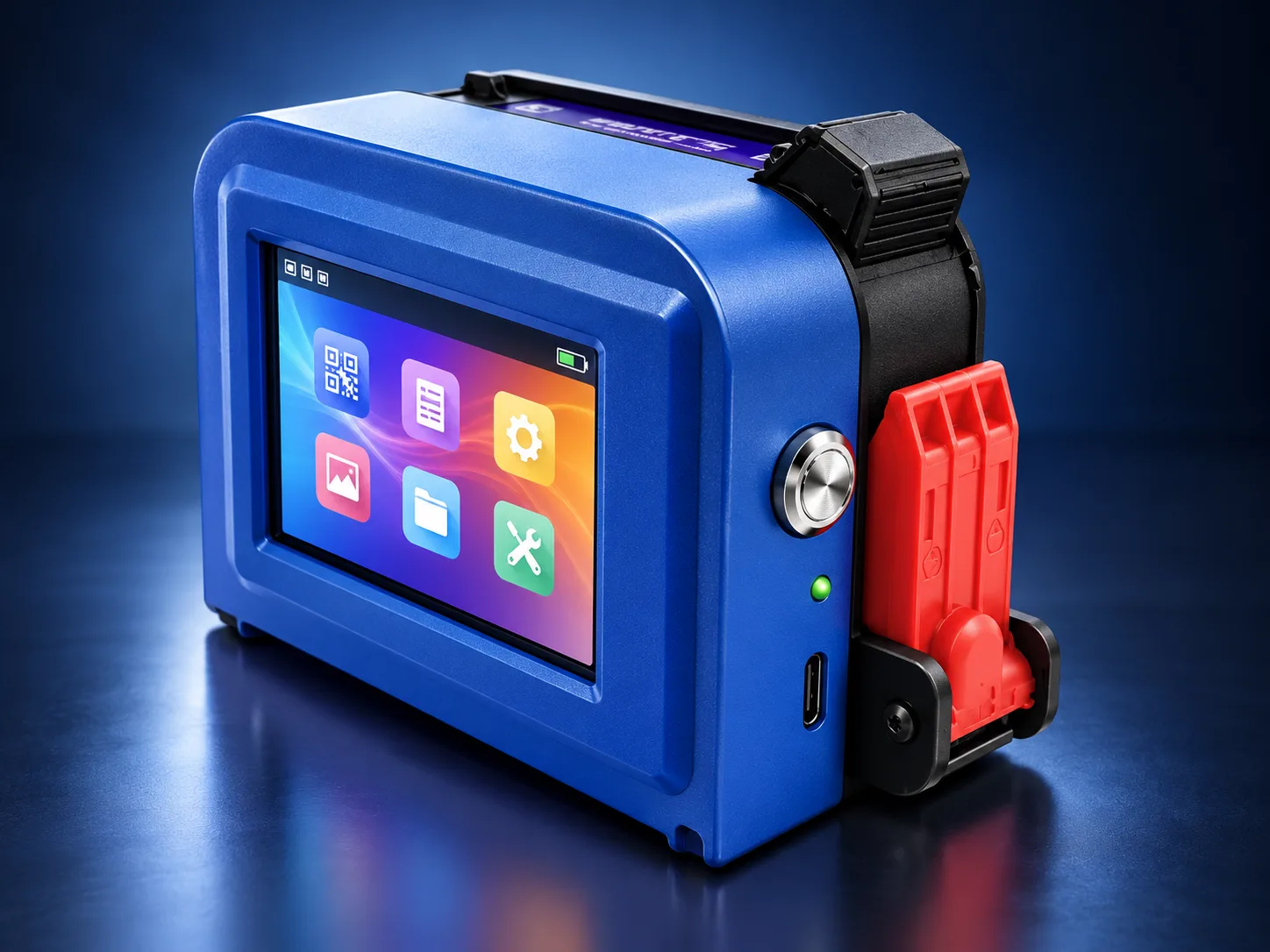
TIJ (thermal inkjet): a printer that ejects ink drops by heating tiny resistors in a cartridge-based printhead. See thermal inkjet printers: handheld and inline.
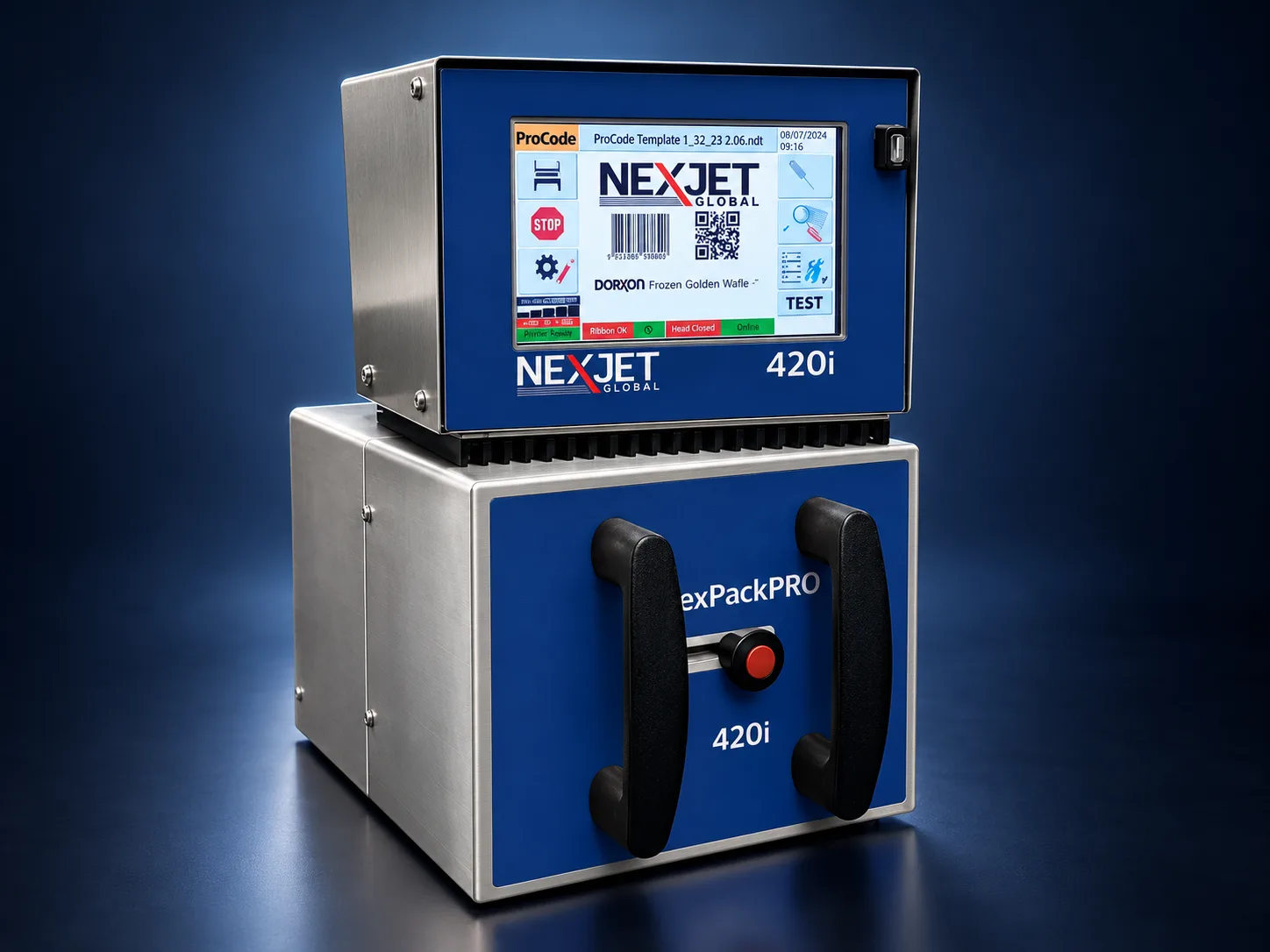
TTO (thermal transfer overprinting): printing on film or labels by melting ink from a ribbon with a heated printhead. See thermal transfer overprinting for flexible packaging.
U to W
UV laser: a laser with a wavelength of 355 nm that marks with very little heat, suited to sensitive plastics, films and fine detail. See laser marking: choosing fiber, CO2 or UV.
Variable data: content that changes from pack to pack or batch to batch, such as dates, counters and serial numbers.
Viscosity: how thick or runny an ink is. CIJ printers monitor and correct it continuously.
Vision system: a camera that checks each printed code for presence, content and readability, and can reject faulty packs.
Wavelength: the colour of laser light, measured in nanometres (nm). It decides which materials a laser can mark well.
Ready to compare equipment? See the CIJ coding inkjet printer and the TTO 420i, or start with choosing a coding technology by material.
إرشادات تحريرية مستندة إلى كتالوج شركة NEXJET. وهي ليست نشرة بيانات لطراز محدد.