
How does thermal inkjet work?
Tiny resistors in the printhead heat the ink for a few microseconds. A vapour bubble forms and pushes a drop out of the nozzle; when the bubble collapses, the chamber refills. Many nozzles fire in patterns to build the code at high resolution.
Because the printhead is built into the cartridge, every cartridge change gives you a new printhead. There is no ink system to flush, no make-up fluid and very little routine maintenance.
What can a TIJ printer print?
TIJ prints high-resolution text, graphics and codes within the print height of each cartridge:
- Dates, batch numbers, times and counters
- Barcodes and 2D codes such as GS1 DataMatrix and QR, with the scan grade checked on the real material
- Logos and product text
- Arabic text and Hijri dates, where the controller software supports them
Each cartridge covers a fixed print height. Taller codes need several cartridges working together or a wide-format printer.
Which materials suit TIJ?
TIJ performs best on porous surfaces and can code some non-porous materials with the right ink:
- Porous: cartons, corrugated cases, paper labels, paper bags and wood. Water-based inks give clean, sharp codes.
- Non-porous: coated cartons, films, plastics, metal and glass. Solvent-based TIJ inks dry fast, but cartridges must be capped when idle because the ink can dry in the nozzles.
Drying time and adhesion depend on the ink and the surface, so confirm them on your own samples.
Handheld or inline: what is the difference?
Both use the same cartridge technology, but the workflow, speed and handling requirements are different.
Handheld TIJ
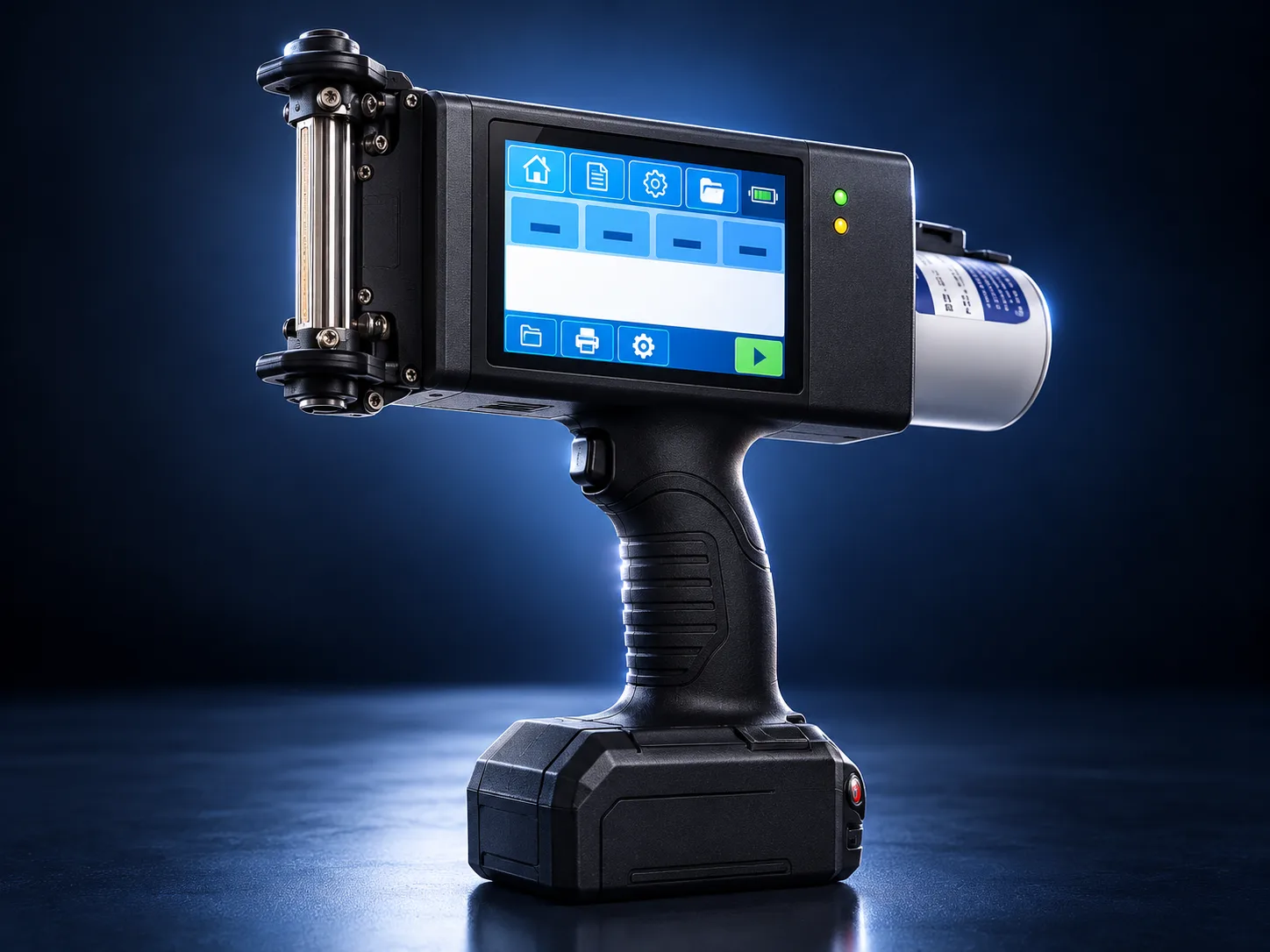
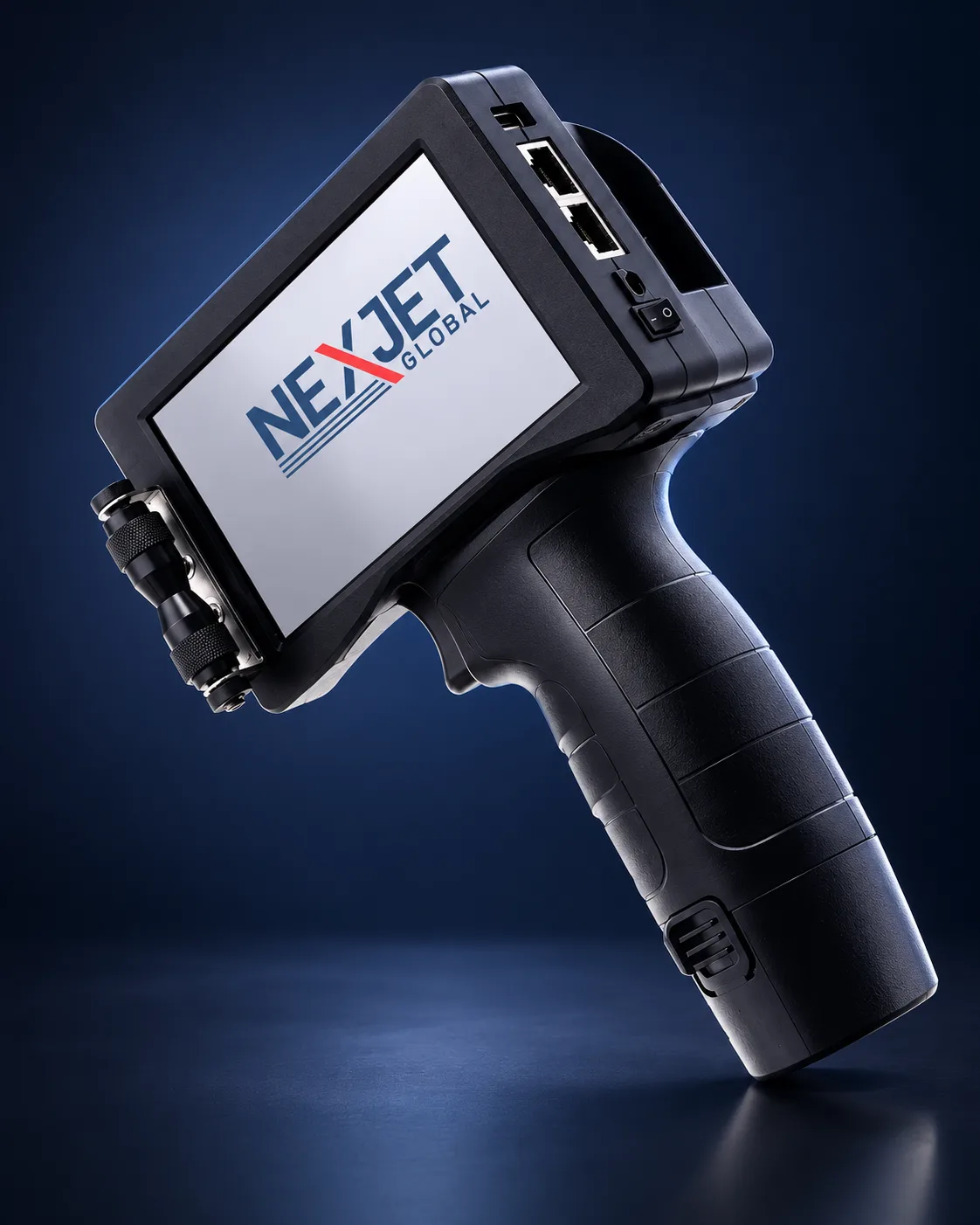
The operator moves the printer across the product while a wheel or sensor measures the movement, so the code keeps its proportions. Handheld printers suit low volumes, heavy or irregular items that do not travel on a conveyor, cases and pallets, and occasional coding in warehouses. Print quality depends on the product surface, any guide used, the code size and a steady, repeatable hand movement.
Inline TIJ
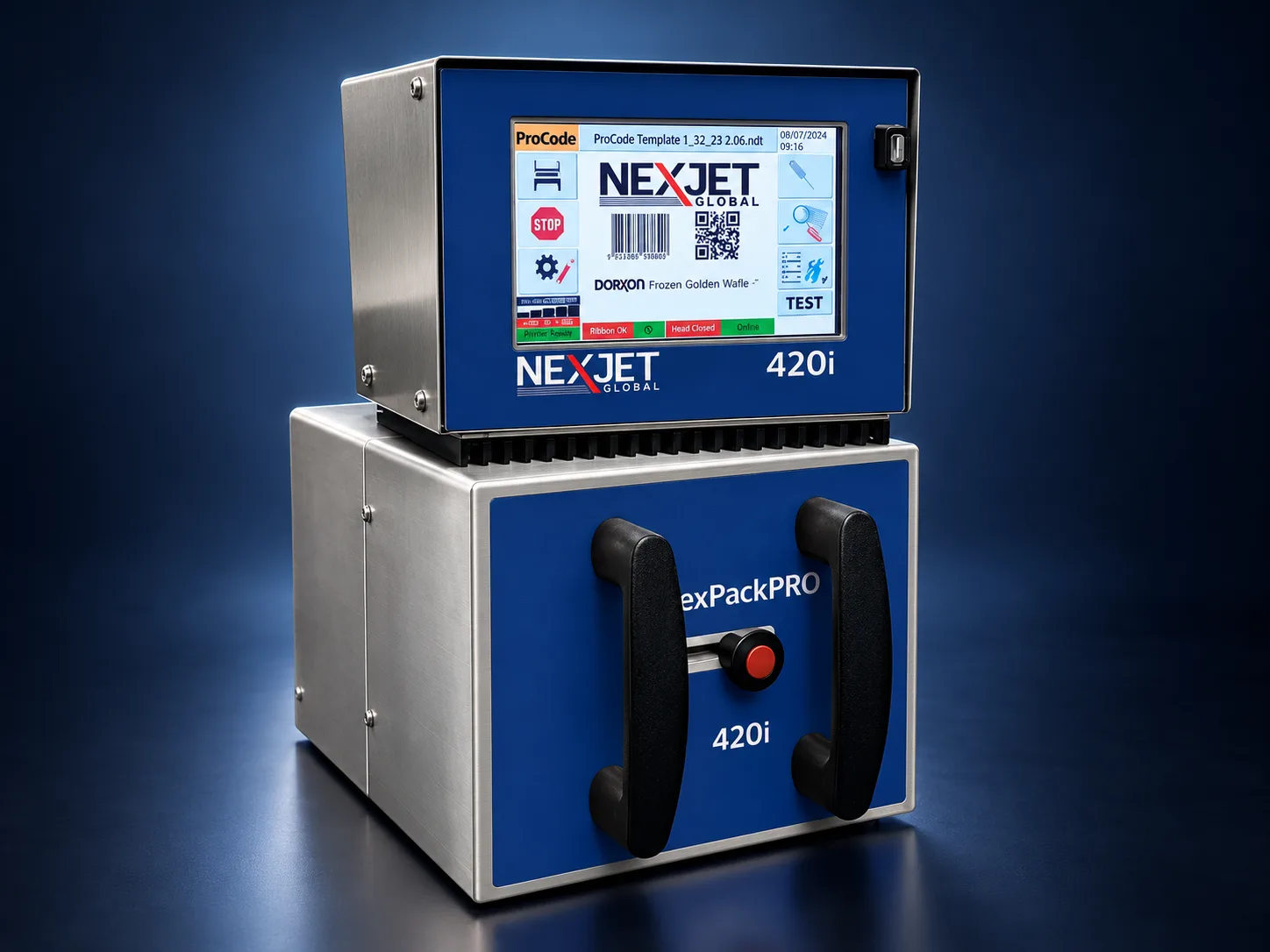
Fixed printheads sit beside the conveyor. A product sensor triggers each print and an encoder matches the code to line speed. Inline TIJ suits continuous production of cartons, labels and compatible packs. Because the product must pass close to the printhead at a steady distance, triggering, head distance, conveyor stability and product guides all matter.
Which NEXJET TIJ printer fits which job?
- Handheld TIJ: portable coding of dates, batch numbers and codes.
- Mini Hand Jet: compact portable marking.
- Wide-format handheld: large characters on cases, bags and industrial surfaces.
- Portable expiry-date printer: manual date and lot coding.
- Inline TIJ (EP Jet): fixed printheads for cartons, labels and compatible packaging on moving lines.
Specifications differ between these models. Print height, speed, cartridge type and battery details for one model do not carry over to another, so check each product page and its datasheet, and confirm the head count and integration requirements in your quotation.
What are the limitations of TIJ?
- Short throw distance: the product must pass close to the printhead and at a steady distance.
- Limited print height: each cartridge covers a fixed height.
- Speed versus resolution: printing faster usually means lower resolution in the direction of travel. Never assume maximum speed and maximum resolution at the same time.
- Solvent cartridges: they can dry out if left uncapped between runs.
When is TIJ the right choice?
Choose TIJ when you need sharp text or 2D codes on cartons and labels, want clean cartridge changes with little maintenance, or run intermittent or mixed production.
Consider a CIJ printer for curved, wet or uneven surfaces at high speed, and a thermal transfer overprinter for flexible film on a packaging machine.
Still comparing technologies? Read choosing a coding technology by material.
Frequently asked questions
How long does a TIJ cartridge last?
It depends on code size, resolution and how much ink each code uses. Ask for the yield at a stated print coverage and, for solvent inks, how long the cartridge can stay uncapped.
Does TIJ need much maintenance?
Very little. Wipe the cartridge nozzle plate as instructed and cap the cartridge when idle. There is no ink system to service.
Can a handheld TIJ printer code curved products?
Gentle curves are sometimes possible. Tight curves and uneven surfaces usually code better with CIJ, which prints across a larger air gap.
Can TIJ print GS1 DataMatrix codes?
Yes, on suitable materials. Check the printed code with a barcode verifier to confirm it reaches the grade your customer or regulator requires.
Editorial guidance informed by the NEXJET company catalogue. This is not a model-specific datasheet.